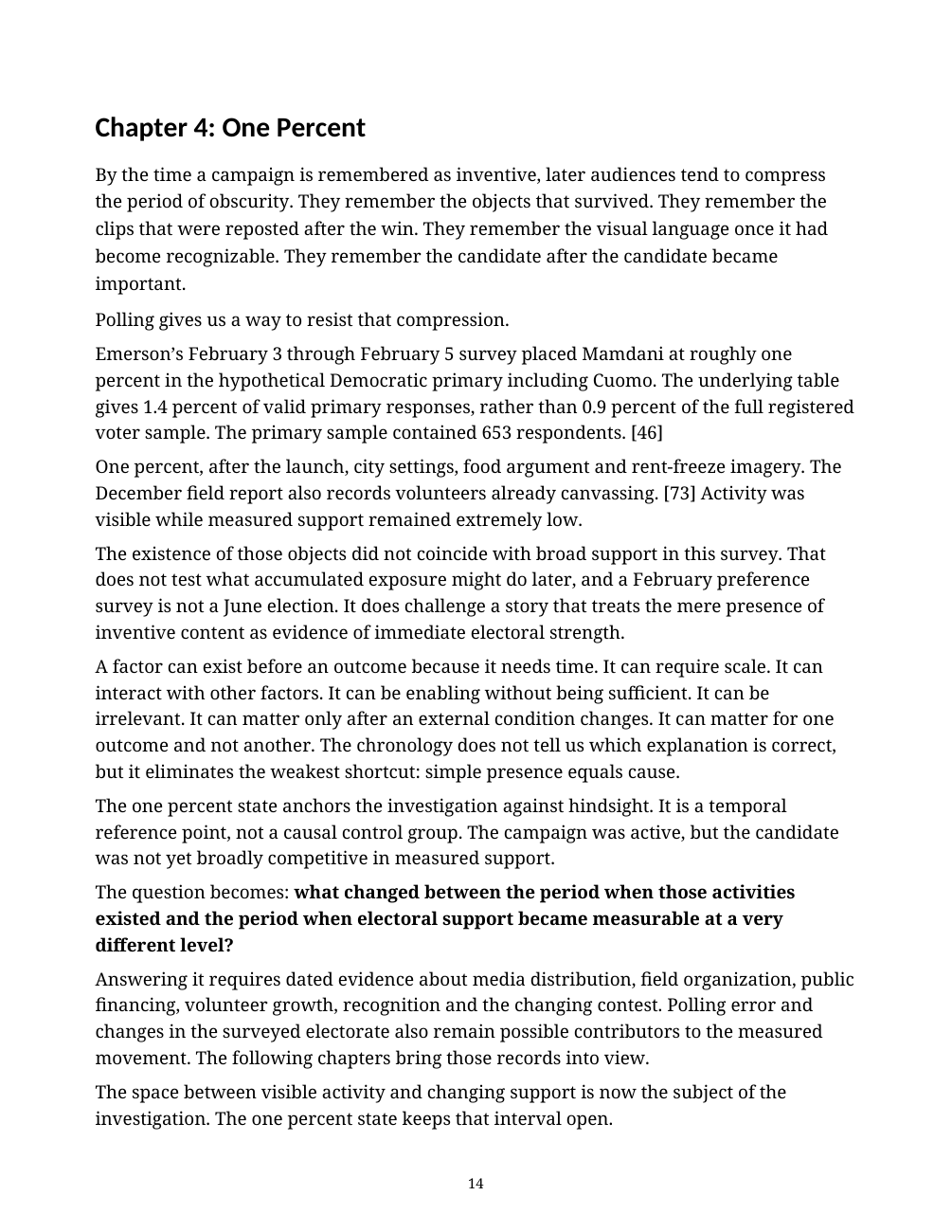
Open full-size page
Sequence is not cause
Three dates.
Three different questions.
The method distinguishes the filmed event date, upload date and earliest documented meaningful circulation date. A repost does not change the original event date. Dates without sufficient evidence remain unknown.
The same discipline applies to claims: an early event is not automatically a cause, and a view is not a vote.
Read the page text
Method Political campaigns generate stories about themselves. Opponents generate counter stories. Journalists compress sequences into narratives. Supporters remember moments that now look decisive. Losing campaigns remember different moments. Winning campaigns acquire the additional hazard of inevitability: once the result is known, earlier fragments begin to look as though they had always pointed toward it.
This book treats chronology as a control against that distortion. An event is not a cause merely because it happened first. A view is not a vote. A follower is not a supporter. A volunteer signup is not an active volunteer. A public promise is not legal authority. An appropriation is not an operating program. A repeated claim is not independent confirmation. A book about a political figure is not automatically a reliable source about that figure. The book distinguishes established events from possible causal pathways. Competing explanations remain in the narrative wherever the evidence leaves them open. Where the record does not answer a question, the answer is unknown.
Date Discipline
Every video record keeps three dates separately:
1. Event date: when filming or the depicted event occurred.
2. Upload date: when that particular version was posted to its identified platform.
3. Circulation date: when it first reached meaningful public attention.
An upload date is not an event date. A repost is another upload, not a new date for the filmed event. Different edits and platform copies retain separate records.
Every article record also keeps three dates: 1. Publication date.
2. Dates of the events described.
3. Date the author’s information was gathered, if stated.
Unknown dates are marked UNKNOWN. A known month or range is retained at that precision, with any missing day explicitly unknown. Publication does not establish when an interview took place. A later article can describe an earlier event using information gathered at another time.